
What America Lost: The Slow Death of the American Promise.
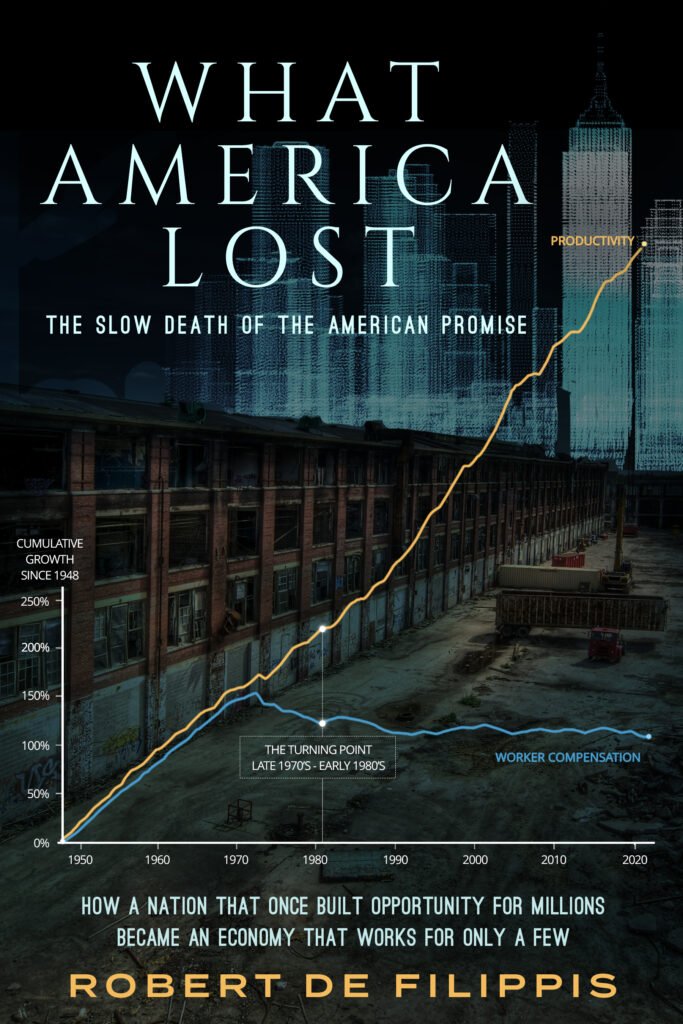
For much of the twentieth century, ordinary Americans believed in a simple promise.
If you worked hard, played by the rules, contributed to your community, and saved for the future, you could build a stable and meaningful life. You might not become wealthy, but you could own a home, raise a family, retire with dignity, and expect your children to have opportunities equal to or greater than your own.
That promise helped build the American middle class.
Today, many Americans sense that something has changed. Wages struggle to keep pace with rising costs. Job security has been replaced by uncertainty. Communities have weakened. Trust in institutions has eroded. Millions of people work harder than ever while feeling further behind.
What happened?
In What America Lost: The Slow Death of the American Promise, author Robert De Filippis examines one of the greatest transfers of wealth and power in modern American history. Drawing upon more than forty-five years of experience as a manufacturing executive, management consultant, executive coach, business owner, and observer of American institutions, he tells the story not as an academic theorist, but as someone who watched the transformation unfold from the inside.

🎙 Listen to the AI Podcast
Experience an AI-generated conversation exploring the ideas, questions, and insights behind What America Lost. Discover the story beneath the story.
The book traces the evolution of American business from a culture of stewardship to one increasingly driven by extraction. It explores the rise of shareholder primacy, the outsourcing of jobs, the decline of pensions, the growth of the gig economy, the consolidation of economic power, and the gradual shift of risk from corporations to individuals.
Yet this is not merely a book about economics.
It is also a story about language, culture, values, and the invisible social bonds that once connected employers, employees, families, neighborhoods, and communities.
It asks what happens when institutions stop viewing people as citizens and begin viewing them primarily as consumers.
Most importantly, the book challenges readers to consider whether the American Promise can be renewed.
Whether you agree with every conclusion or not, What America Lost invites an honest conversation about how we arrived at this moment, what has been gained, what has been lost, and what kind of future we wish to create for the generations that follow.
Because before we can rebuild the promise, we must first understand how it was broken.